Some Pilates Essentials for slowing down bone loss and improving our bone health with strength and resistance.
Develop balance, strength and flexibility in correct alignment and posture.
Strength and resistance training using weights, bands, toning rings in addition to impact exercise is key for maintaining muscles mass and bone density. Bones respond to mechanical loading or stress place upon them.
The force generated by pulling on tendons attached to bones when you move, stresses the bone and this stimulates bone remodelling.
Stronger muscles! Stronger bones!
Resistance training means working your muscles against force to become stronger and this becomes very important as we get older as muscles decline in strength. Strength training exercises for improving bone are site specific which means you work particular muscles groups to strengthen specific bones in the body. If you want to build bones in your arms and shoulders, you need to stress the muscles in your arms, so the muscles are pulling on bones. Similarly, if you want to strengthen the bones and muscles in your hip you need to do exercises that specifically target your hips.
Progressively becoming stronger – Progressive Resistance Training
As we improve and become stronger, we need to gradually increase the intensities of the bands or weights we are using. The intensity must be challenging enough to make a positive difference but also must be progressed in a safe way with good technique.

Start with lighter bands and weights and gradually increase the intensity until you find you can only manage 8-10 reps consecutively with good technique. When you can do 15 -20 reps fairly easily I recommend you increase your weight by 1/2 kg. We also need to vary the exercises with changes of direction and moving patterns, so we continue to progressively challenge ourselves.
Specific exercises we can do to build and maintain strength in our legs and hips for preserving our independence include functional strength exercises like squats and lunges in various forms essential for walking, going up stairs, and for balance. The squat is one of the most important functional moves you can do for many of our essential activities in daily life e.g. getting up from a chair and sitting back down.
You can progress this by slowly sitting down for a count of 10 and rising for 5 counts.


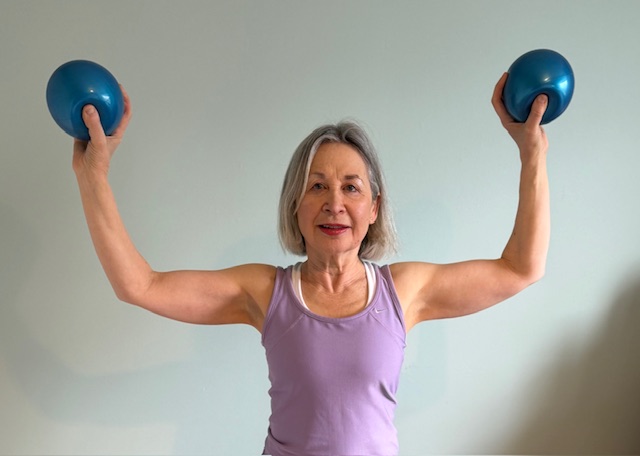
For the upper body exercises such as bicep curls, standing rows, shoulder press using graded weight intensities will help keep our arms and shoulders strong for lifting, pushing and pulling.
