Safe gardening for people with osteoporosis
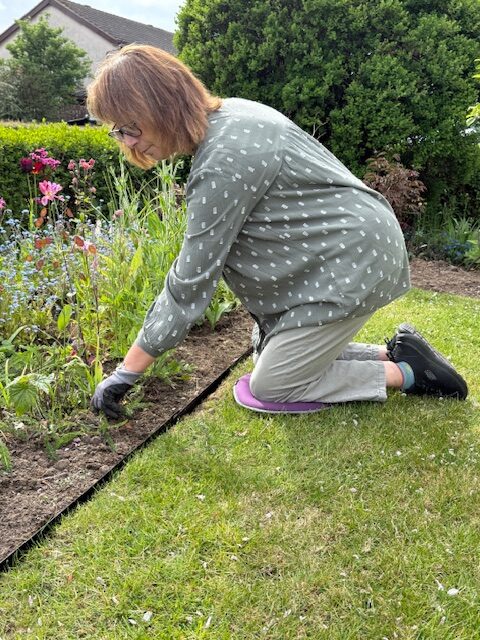
As Spring unfolds towards Summer and the days become longer and warmer it’s the perfect time to spend time outdoors tending and nourishing our garden and ourselves with sunshine (vitamin D!) movement and creativity as we plant and grow our favourite flowers, herbs, fruits and vegetables.
Gardening is a good way to keep fit through functional and mindful movement which enable us to take care of our muscles and bones. Many of the typical strength movements we do here include pulling, pushing, lifting, carrying, and bending which challenge our strength and flexibility.
So here are some tips for gardening safely:
- Avoid bending from the waist, excessively rounding your upper back. Instead, hinge at your hip keeping your back straight, your spine in line and your knees soft or gently flexed.
- Use a garden kneeler to protect your knees (if kneeling is an option). Alternatively, a gardening stool may help to maintain a more neutral back and reduce strain in the spine.
- Another option might be to cultivate raised beds to bring the garden up to you. This will help to minimise bending.
- Lift the right way. Bend your knees, keep items close to your body. Engage your core prior to lifting. Do avoid twisting when lifting and ensure you are NOT lifting an object beyond your physical capability. You might consider carrying smaller loads and filling smaller watering cans.
- Take breaks, listen to your body. Stand, stretch, and walk around every 15-20 minutes to reduce stiffness and overuse.
- Wear supportive shoes and avoid stepping on uneven surfaces where you could slip or trip – think rockeries!
Assuming your garden is suitable you may wish to plant some green leafy vegetables rich in calcium like kale and broccoli.
As you plant seeds and flowers, pull weeds and push lawnmowers and carry bags of compost, strong bones like healthy gardens thrive and grow stronger!

Pilates Exercises for you to practice to protect your back and move with ease
Cat – Cow – to mobilise the spine and warm up the back body. On all 4’s, inhale to lift your chest and look up, then exhale as you round your body lowering crown of head, tucking tailbone and tummy in.
Pelvic curl into bridge – to activate your glutes and hamstrings to support lifting. Lying supine, exhale, tilt your pelvis and peel your spine off the mat. Inhale hold, then exhale to peel segmentally down.
Spine twist – to warm up the waist and improve rotation. Sit tall with arms wide level with your shoulders. Exhale to rotate gently and slowly to one side. Inhale and return to centre, ehale to twist to the other side.
Shoulder rolls and arm circles – to prepare your shoulders for digging, raking and lifting. Roll your shoulders back for 8 then forward for 8. Now evolve this into arm circles for 8 reps both ways.
Swimming – to strengthen your back muscles and glutes. Lie face down on your front. Extend your arms in front. Pull your naval in off the mat. Lengthen and lift opposite arm and leg on exhale, inhale lower. Repeat other side. Remember to keep your neck long, in line with your head as you lift.
Side leg lifts – to strengthen your hips and improve lumbar and pelvic stability. Lie on one side in a straight line, stacking your legs, hips and ribs and shoulders. Lengthen and lift your top leg in line with your top hip or a bit higher, then lower. Ensure your lower waist is not sinking down into the mat and make sure you are not rolling back with your hips. You can place your top hand down into the mat for support and stability.
Bird dog – to improve balance and core stability. Come on to all 4’s on hands and knees. Extend opposite arm and leg and hold for 3 full breaths. Now change to your opposing diagonal.
Squats – strengthens lega and hips for safe lifting . 10- 15 reps
Chest Expansion – to improve your posture after flexing or bending forward. Stand tall, pull arms down and behind you interlocking fingers, inhale and lift and open your chest. Exhale and release. x 5-6 times.
Important tips to take on board
Maintain a strong core – draw naval in towards your spine on your exhale when pulling weeds, lifting pots, digging, pushing a wheel barrow. A strong core reduces pressure on your lower back.
Hinge at the hip crease – not at the waist. Avoid rounding through your upper and lower back. Instead,soften knees, send hips back and keep your spine long from your head to midback to your base of spine.
Use your legs for lifting – squat with bent knees, engage glutes and thighs, exhale as you lift. Legs are stronger than your back and shoulders.
A few stretches afterwards would be good to aide recovery! Some examples could include :
standing sidebends with arm over head
figure 4 glute stretch (supine on a mat)
childs pose taking hips to heels and opeing knees apart – great for lower back stretch.
By applying these principles, we can protect our spine and posture, strengthen our core and move more efficiently!
Gardening is a workout and like any workout requires opreparation, proper form and technique and recovery.